
Your shopping cart is empty!
- Studio & Recording
- Live Sound
- Room Acoustics
- Software & Plug-ins
- Guitars
- Bass
- Keyboards & Synthesizers
- Microphones
- Drums & Percussion
- DJ Equipment
- Accessories
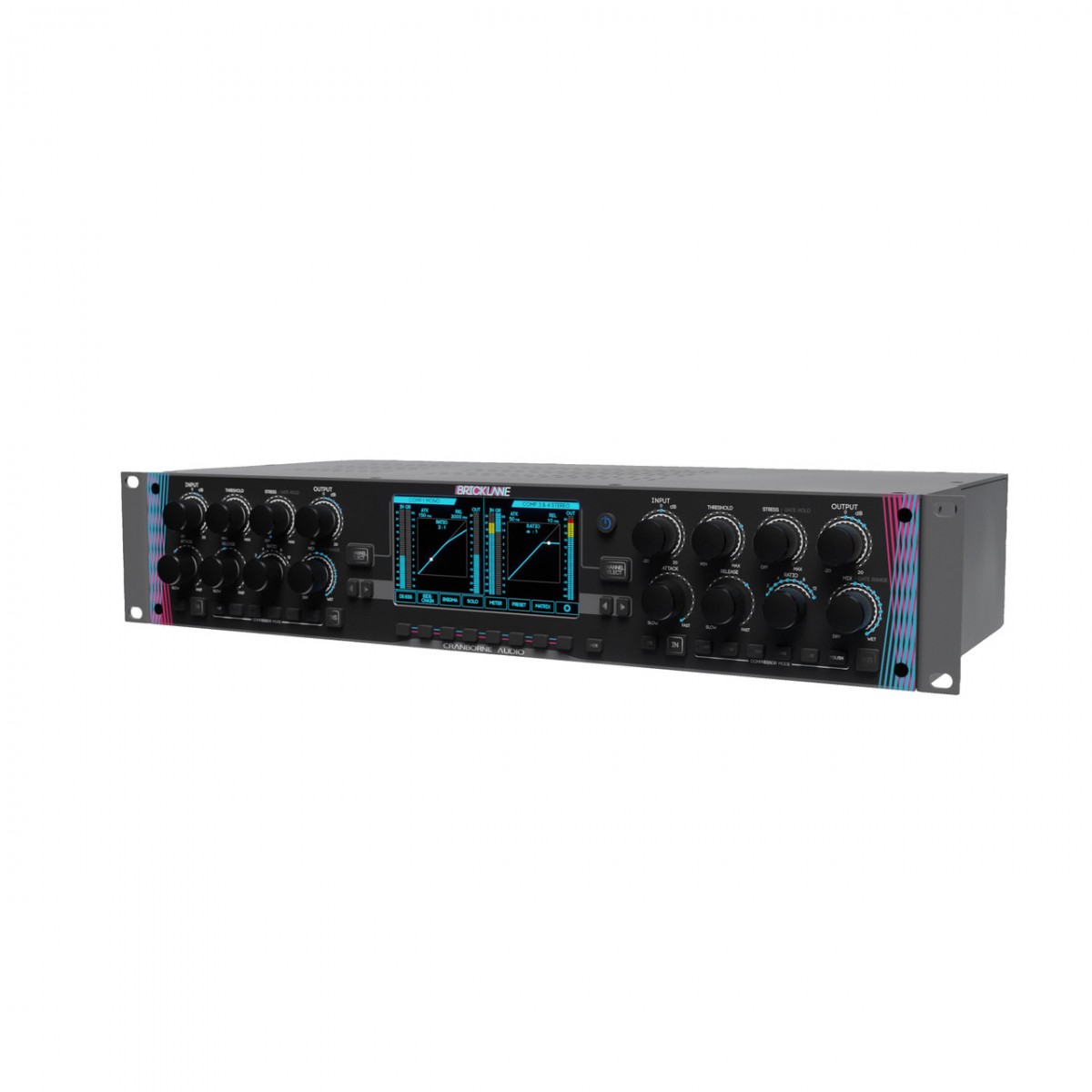
Cranborne Audio MC4 Overview
The Brick Lane MC4 is a completely analog, 4-channel rackmount compressor featuring groundbreaking compression circuitry, building on Cranborne Audio’s modal pulse-width modulation compression technology, which was pioneered by the Brick Lane 500. Brick Lane MC4, like its single-channel predecessor, is based on Cranborne Audio’s proprietary Modal PWM technology and includes six highly useful compression modes. However, it goes much further with stereo and mid-side processing, as well as combinable series, dual-band, and mid-side modes, advanced noise gating and de-essing with analog lookahead, six harmonically enriched analog saturation types, and much more. We get our hands on every decent dynamics control device that comes out, and we’ve never seen one quite as successful in transforming the sound character of a signal.
Sonic transformation.
Cranborne’s Modal PWM compression technology, a digitally controlled analog dynamics architecture that allows for numerous, genuinely diverse compression behaviors within a single signal channel, is responsible for the Brick Lane MC4’s exceptional performance. Modal PWM compression, unlike traditional dynamics-control protocols that rely on changing ratios or thresholds, uses pulse-width modulation to modulate the dynamics control, time constants, and harmonic behavior of the analog gain stage, allowing Brick Lane MC4 to provide a wide range of compression responses while maintaining vanishingly low distortion, quick response, and precise control. The inherent adaptability of this one-of-a-kind technology is manifested in Brick Lane MC4’s six compression modes, each with specific compression characteristics designed to give a unique sound personality.
Velvet offers a smooth, melodic, and organic vintage vari-mu compression with tube-like harmonics.
Float has transparent opto-style dynamics and smooth, wavelike compression ballistics.
Smash: FET-style compression for aggressive dynamics control, explosive punch, and strong impact.
Tame: Fast and precise transitory management for surgical procedures.
Classic master bus compression adds punch and volume to mixes.
Cranborne’s Analogue Lookahead technology and two switchable settings provide fast and clean mastering-style limiting.
Modal control and harmonic behavior.
You may fine-tune further using standard threshold and variable attack and release controls, the ranges of which vary according to the mode. The frosting on the cake, however, is a one-of-a-kind stress control that allows you to enrich the compressed sound with euphonic even-order harmonic content. The stress control operates inside the modal PWM architecture and introduces dynamics-focused analog harmonic saturation, the behavior of which is determined by the compression mode selected. Rather than using a single, static saturation circuit, Brick Lane MC4 employs six distinct multiband analog saturation circuits, each of which is designed to work in tandem with the behavior of its corresponding Modal PWM modes.
These saturation circuits are dynamically coupled to the gain-reduction process, allowing harmonic content to vary in response to signal level, envelope, and compression action. This comprehensive method evokes the typical non-linearities and program-dependent behavior of traditional analog compressors, in which dynamics, saturation, and tone are fully combined rather than being regarded as separate processes.
Series mode: construct dynamic chains.
Brick Lane MC4’s Series mode allows two of its channels to be routed in series over a single signal line, allowing for sequential dynamics processing without the need for external patching. Series mode is best suited for sources that benefit from layered control, such as voices, bass, and drums. It provides a simple, simplified solution for carrying out this typical studio practice while preserving the precision, stability, and repeatability that current analog workflows demand.
Dual-band mode enables robust multiband analog reduction.
The dual-band mode on the Brick Lane MC4 divides a source into low- and high-frequency bands, which are then processed separately by modal PWM dynamics channels before being recombined. This enables fundamentally diverse low- and high-frequency behaviors to be controlled separately and appropriately. Dual-band mode maximizes low-end punch and definition while maintaining high-end clarity and transient responsiveness by removing the effect of low frequencies on compression action. Brick Lane MC4 also has configurable sidechain highpass filters (60Hz, 100Hz, and 200Hz) that offer comparable capabilities. And while we’re at it, let’s look at Brick Lane’s sidechain inputs.
Sidechain inputs provide important options.
While every dynamics processor contains a sidechain circuit that studies the signal and calculates how much gain is reduced, not all units provide access to the sidechain. In compressors without a separate sidechain input, the primary input signal compresses itself. With compressors like the Brick Lane MC4, you may add extra processing to the sidechain—or introduce a new signal that controls the compression action on the primary signal.
This is a very valuable feature since it decouples dynamic behavior from the audio signal stream when necessary, allowing for precision control without influencing the processed audio. A frequent use case would be to automatically duck one track to make room for another, such as beneath a voice-over, or to generate the iconic EDM mix pumping effect by utilizing a kick drum as a trigger. Brick Lane MC4 offers advanced professional dynamics processing by allowing for per-channel internal and external sidechain choices while still enabling easy, recallable operation.
inserts for outboard hardware
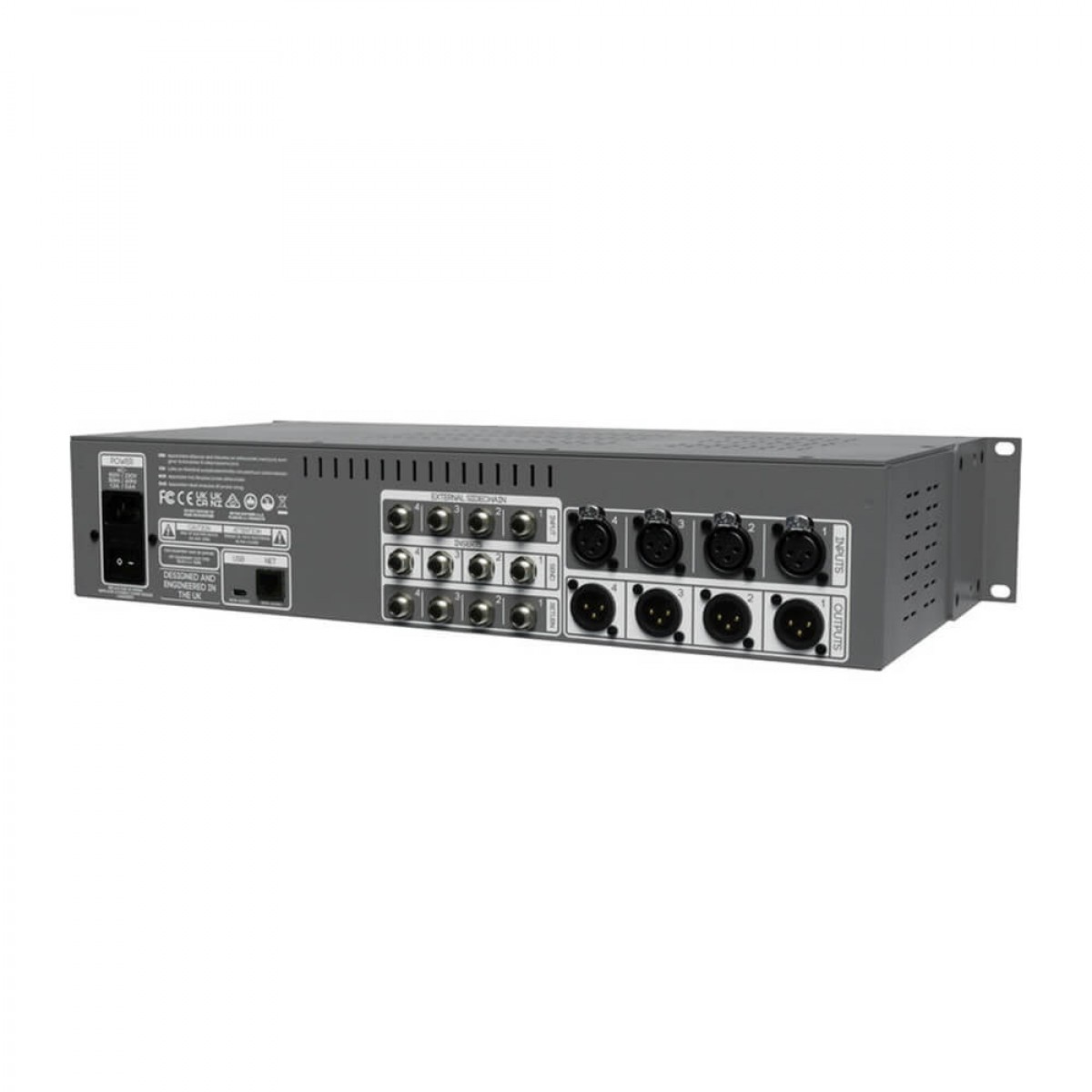
The Brick Lane MC4’s back panel is equipped with bypassable TRS insert points on all four channels, allowing other analog circuitry to be plugged directly into the signal line. Each insert point throughout the processing chain is customizable, ensuring accurate placement relative to the dynamics engine and accompanying processing steps. This versatility allows for a wide range of sophisticated processes, such as adding external EQ, saturation, or other analog processing before or after dynamics processing.
In mid-side operation, the insert points can be placed between M-S encoding and decoding, allowing external hardware to be applied separately to either the middle or side components of a signal. Brick Lane MC4 allows you to create complicated analog signal chains while keeping a simplified, consistent process because it provides fully integrated insert routing without the need for patching or routing gear.
Operating modes include mono, stereo, and mid-side.
Brick Lane MC4 integrates smoothly with a wide variety of professional workflows. Brick Lane MC4 is a must-have instrument for tracking, mixing, and mastering, with each of its four dynamics channels capable of standalone mono processing, connected stereo operation, or mid-side processing. Stereo linking provides coherent gain reduction across linked channels when processing stereo sources or buses, preserving visual stability. Mid-side (M-S) mode gives you precise control over a mix’s center and lateral components, allowing you to dynamically shape voices, bass, ambiance, and mix breadth while remaining mono compatible. Brick Lane MC4’s routing architecture allows it to dynamically switch between corrective dynamic control, creative augmentation, and final polishing chores.
Benefits of Mid-Side Processing
Mid-side processing is a stereo encoding/decoding technology that opens up a delectable menu of picture-enhancing options. Audio professionals value it for its coherent phasing and watertight mono compatibility. Mid-side processing has long been employed in vinyl disc mastering to reduce lateral and vertical cutting lathe head excursion. It is also effective in mixing, mastering, and sound design for broadening the stereo soundstage and tightening and concentrating the bottom end by summing only the bass frequencies to mono.
The Brick Lane MC4 has a mid-side processing mode that lets you compress and enhance the individual mid (center) and side (lateral) components of a stereo sound. The Brick Lane MC4 performs all of the required encoding and decoding, eliminating the need for extra M-S processing hardware or software. When used correctly, Brick Lane’s mid-side capabilities may result in mixes that are wider, deeper, more focused, and stronger.
Comprehensive local and remote control.
Brick Lane MC4 has a straightforward control interface that includes a 5-inch full-color TFT screen, LED rings, and digital encoders for extensive control and detailed visual feedback on all settings. Beyond its faceplate, the Brick Lane MC4 takes management to the next level by allowing all parameters to be controlled remotely via USB or Ethernet. Cranborne Audio’s remote control plug-in interacts flawlessly with the Brick Lane MC4 hardware device via its rear-panel USB or NET connections, allowing for extensive real-time control and recall, as well as preset storing and loading straight from your DAW.
Unrivalled value and adaptability
The Cranborne Audio Brick Lane MC4 in one 2U rackmount chassis not only provides access to every traditional style of dynamics control you’d ever use, but it also serves as a blank canvas for quickly creating your own, transforming compression from a utilitarian function to a creative instrument. Packing your rack with different compressors would easily cost five figures to match what the Brick Lane MC4 can achieve. Of course, you’d lose the wonderfully streamlined operating efficiency. All of this makes the Cranborne Audio Brick Lane MC4 an incredible value—and the best dynamics processor for the modern studio.
Cranborne Audio’s Brick Lane MC4 features:

Free Shipping

Free Consultancy

Fast Delivery
Sapna Trade Centre, 2nd floor 2B,
New No. 135, Old No.109,
Poonamallee High Road,
Chennai – 600 084.
mukesh@promusicals.com / vivin@promusicals.com / support@promusicals.com
9884304425 / 9884304426 / 9884631886 / 044-2819 3607 / 044-2819 2934
7305574447 / 9995239203
Monday To Saturday
10.00 am to 07.00 pm
ProMusicals © 2020
Made with ♡ by iTGS


ProMusicals © 2026

Reviews (0)